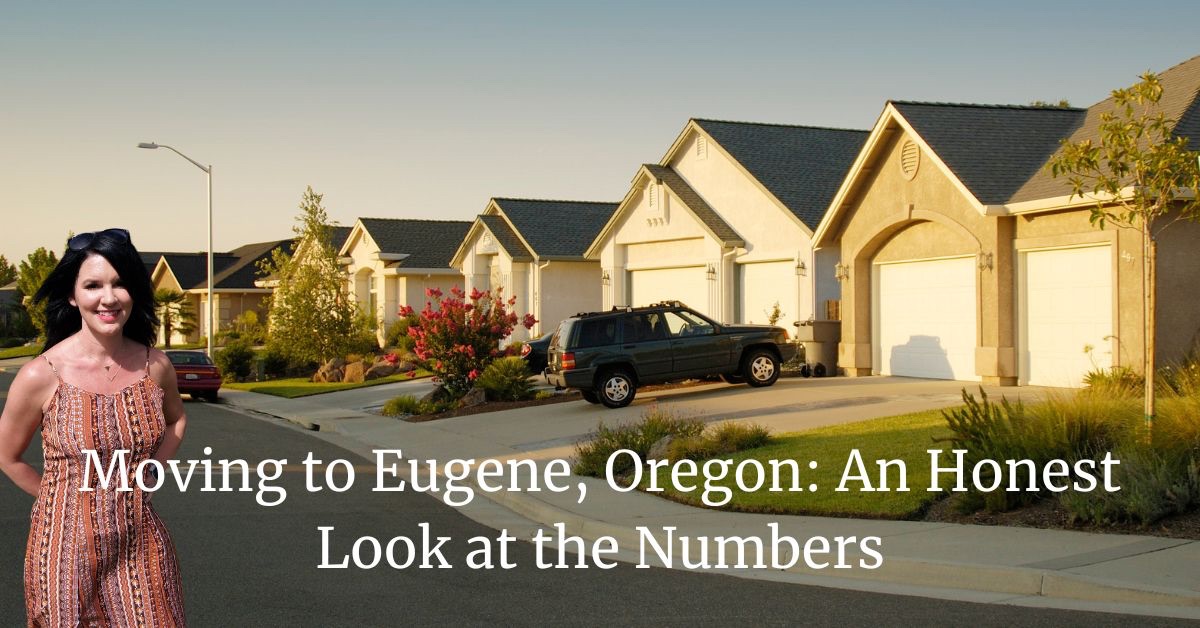
Moving to Eugene, Oregon: An Honest Look at the Numbers

Most "moving to Eugene" articles are written by people who have never driven Beltline at 5pm.
They tell you it rains a lot and the town loves running. Then they stop.
Here is the version I give people who call me from out of state, with the actual numbers behind it.
What does it cost to live in Eugene?
Eugene runs above the national average, and housing is the reason.
The cost of living comparisons out there put Eugene somewhere between 8% and 13% above the national average depending on whose index you read. Housing specifically comes in around 17% to 19% above average. Utilities are the bright spot at roughly 7% below average, thanks to cheap Pacific Northwest hydropower. Groceries and healthcare both run about 5% to 18% above average depending on the source.
Median household income in Eugene sits around $63,800 to $66,500, compared to a national median closer to $74,600.
Read that gap again, because it is the whole story. Eugene costs more than the average American city and pays less than the average American city.
That does not mean it is a bad move. It means the people who do well here either bring income with them (remote work, retirement, a transfer) or they buy at a price point that matches an Oregon salary instead of a California one.
Is Eugene affordable compared to the rest of Oregon?
Yes, and this is where Eugene actually wins.
Statewide, Oregon's median home price sits near $484,700. Portland runs around $529,000. Bend is up near $775,000.
Lane County's median sale price in July 2026 was $466,000, according to RMLS data reported by Lookout Eugene-Springfield.
So you get Willamette Valley access, a real airport, a Division I university, a major medical center, and the Cascades an hour east, at a price that undercuts Portland by a meaningful margin and undercuts Bend by a lot.
That is the pitch. It is a real one.
The rain conversation
People fixate on this, so let's use real numbers instead of vibes.
NOAA's 30-year climate normals put Eugene at about 40.8 inches of rain per year across roughly 146 rainy days. For comparison, the national average is around 38 inches. So Eugene does not get dramatically more rain than the rest of the country.
What Eugene gets is fewer sunny days. Around 155 per year, against a national average closer to 205.
And the rain is not spread evenly. December averages over 7 inches. August averages about a third of an inch. June through September is a genuine dry season, and those months are the reason people fall in love with this place.
Here is the part nobody says out loud: it is not the rain that gets people. It is the gray. November through February the sun sets early and the sky sits low. If you visit in July and buy in July, you have only met half of Eugene.
If you are seriously considering a move, come in January. I mean that as advice, not as a warning.
Oregon taxes: the trade you are making
This one catches relocating buyers off guard in both directions.
No sales tax. Oregon is one of only five states with no state or local sales tax. On a $50,000 vehicle that is a savings of several thousand dollars. On groceries, clothing, appliances, and everything else, it adds up quietly all year.
High income tax. Oregon's brackets run from 4.75% up to 9.9%, and that top rate kicks in at a much lower income level than most people expect. If you are moving from a no-income-tax state like Washington, Texas, or Nevada, this will sting.
Property taxes are more predictable than most states. Measure 5 caps property taxes at $10 per $1,000 of assessed value. Measure 50 caps growth in assessed value at 3% per year, no matter what the market does. Oregon's effective property tax rate averages around 0.93%, below the national average of roughly 1.1%.
That Measure 50 cap is one of the more underrated benefits of buying here. Your assessed value and your market value are two different numbers, and over time the gap works in your favor.
One thing to plan for: Oregon's estate tax threshold is $1 million, which is one of the lowest in the country. If that is relevant to your situation, talk to an estate attorney before you establish residency, not after.
I am a broker, not a CPA. Run your specific numbers with a tax professional before you make the call.
What about jobs?
The Eugene-Springfield metro unemployment rate was 4.7% in April 2026, per Bureau of Labor Statistics data, up about 0.4 points from a year earlier. Statewide Oregon has been running near 5.2%.
Oregon lost jobs over the prior year, with professional services, manufacturing, and retail taking the biggest hits. Health care and construction have been the steadier sectors.
The local economy leans heavily on the University of Oregon, health care, state and local government, and manufacturing. It is not a deep or diversified job market for high-earning private sector roles.
If you are moving here without a job already lined up or portable income, that is the single biggest risk in this whole decision. Not the rain.
What the housing market is doing right now
Lane County did something in July 2026 that it has only done once in the last eight years. Prices fell year over year.
The July median was $466,000, down 1.3% from $472,300 in July 2025. Homes that sold spent an average of 49 days on market. Inventory ticked up to 2.6 months from 2.4 in June.
Rates were part of it. The 30-year mortgage rate climbed from 6.43% at the start of July to nearly 6.7% by month's end, per Freddie Mac.
For the year through July, new listings were down 5.1%, pending sales down 1.7%, and closed sales down 0.6%, with median prices up 1.1%.
What that means for you as a buyer: this is not a market where you are getting steamrolled. Two and a half months of inventory is still tight, and well-priced homes still move fast. But you have room to inspect, room to negotiate, and room to walk away. That was not true a few years ago.
Should you move to Eugene?
Eugene works well if you are bringing income with you, you want Willamette Valley access without Portland pricing, and you actually like the outdoors enough to go outside in the rain.
It works less well if you need a deep private-sector job market, if seasonal darkness affects you, or if you are expecting "cheap" because it is not Portland.
The buyers I see happiest here are the ones who did their homework on all three of those before they signed anything.
Thinking about a move to Eugene or anywhere in Lane County? I work with out-of-state and relocation buyers constantly, and I am happy to walk you through what your budget actually buys here before you book a trip. Reach out and tell me where you are coming from.
Categories
Recent Posts